A beginner’s guide to intelligent document processing (IDP)
Make the most out of your data and turn document processing from a cost center into a value driver for your organization.

Summary
Intelligent document processing (IDP) is an AI-driven solution for automating document extraction, classification and validation. It empowers organizations to unlock the full value of their data.
How IDP transforms operations:
Utilizes AI technologies like natural language processing (NLP), and optical character recognition (OCR) to process and structure data with precision.
Automates key steps, reducing manual input and ensuring seamless integration into workflows.
Adapts and improves continuously, evolving with organizational needs over time.
Key benefits of IDP:
Improved efficiency and accuracy: Streamlines operations while reducing human error.
Cost and time savings: Achieve up to 20% reduction in costs and 34% faster processing times.
Actionable insights: Leverage valuable data for faster, smarter decision-making.
Enhanced compliance: Strengthen governance with secure, automated data management.
Scalability: Adapt easily to handle growing document volumes across diverse use cases.
Choosing the right IDP software for your organization IDP is critical for modernizing your workplace
Future-forward organizations understand that data, when leveraged right, can be a foundation for success. However, for many enterprises, the torrential volume of data generated from day-to-day operations is constantly outpacing their capacity to effectively manage it.
Deciphering what’s noise and what’s truly valuable from this sea of data can be a challenge — and here is where intelligent document processing (IDP) emerges as a lifeline. By shifting from manual document processing to an automated, AI-driven approach, IDP enables organizations to tap into their data to unlock enterprise-wide transformation.

IDC MarketScape: Worldwide Intelligent Document Processing Software 2025-2026 Vendor Assessment
Hyland is a leader in IDP solutions
Dive into IDC MarketScape's comprehensive assessment of the IDP software market, where Hyland is recognized as a Leader. With our AI-native Hyland Content Innovation Cloud™, we deliver an end-to-end content and processing platform that empowers businesses to transform their operations. Hyland's solutions enable seamless integration, intuitive user experiences and unparalleled compliance, ensuring your enterprise is equipped to navigate the future of IDP.
What is intelligent document processing (IDP)?
IDP is a subset of intelligent automation that uses cutting-edge artificial intelligence (AI) to process information within unstructured and semistructured data. It extracts, reads, recognizes and understands text content before converting it into a structured, accessible format.
Think of IDP as a smart assistant for your business documents — it enables straight-through processing for various dynamic file formats like invoices, contracts, emails and images at speed and scale, all without additional human input. By eliminating the need for cumbersome manual work, it supercharges your operational efficiency and workforce productivity.
IDP solutions are developed to mimic human cognition. By leveraging large language models (LLMs), modern IDP solutions are able to go beyond simple data capture and extraction, enabling deep document understanding and reasoning to truly transform business processes.
> Read more: The future of intelligent enterprise is AI-powered IDP
How does IDP work?
IDP combines automation and optical character recognition (OCR) technologies with capture and contextualized data for an improved level of accuracy.
While many of these capabilities have existed for some time now (think "intelligent capture" solutions), advances in AI and low-code technology have enabled leading software providers to bring to market truly next-generation IDP platforms.
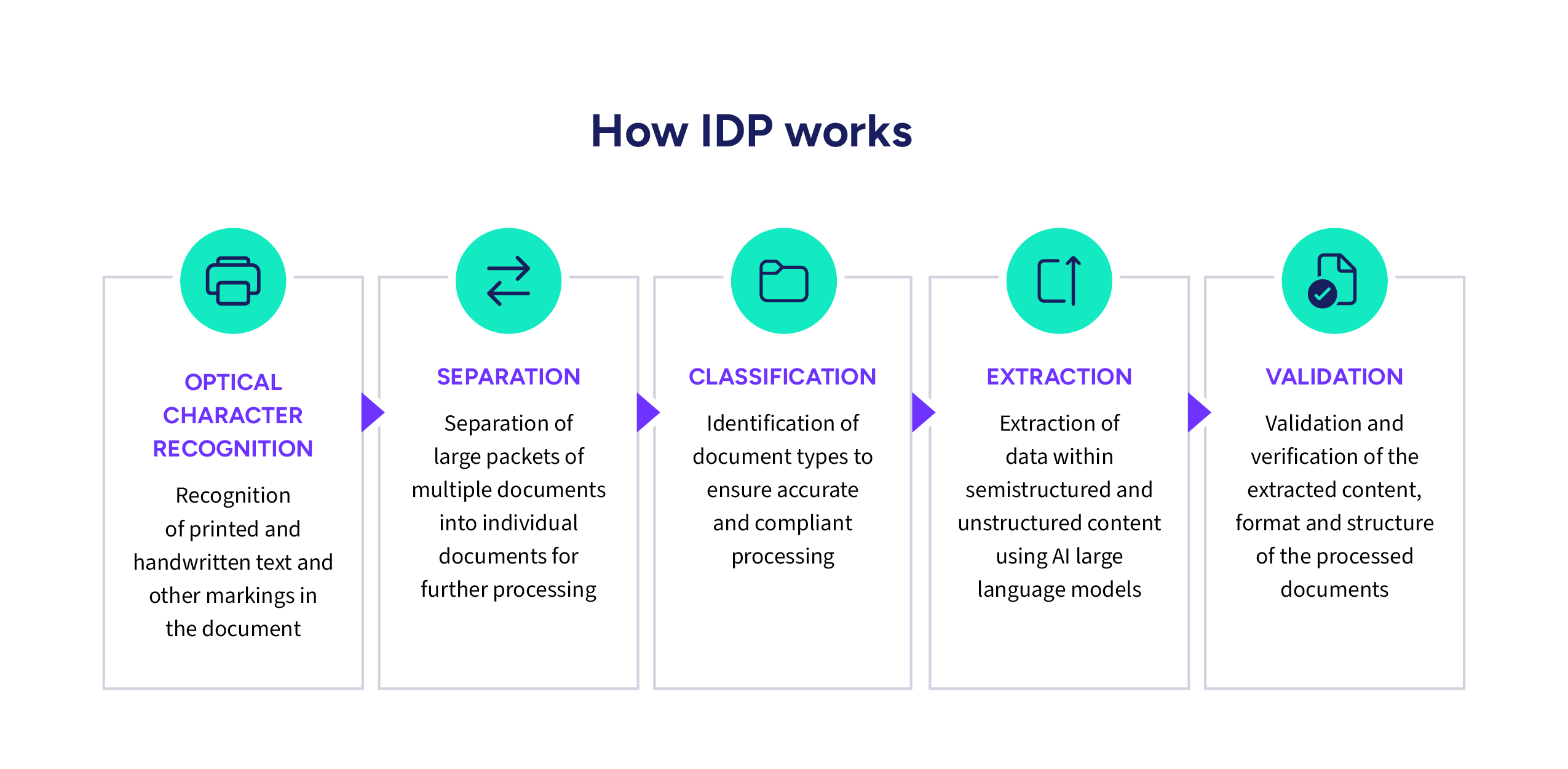
Here’s how an enterprise-grade IDP solution works:
Step 1: Document preprocessing
Documents are ingested into the processing platform and prepared for analysis. They are first scanned through OCR technology and processed using capture techniques like noise reduction and deskewing to enhance data readability and quality.
Step 2: Document separation
Large packets of multiple documents are split into individual documents for further processing.
Step 3: Document classification
The document is then classified based on its content, format and structure. NLP algorithms, which look at data in a human-like way, are then deployed to interpret text contextually to recognize business-critical information.
Step 4: Data extraction
The software then identifies and extracts the relevant data, such as names, addresses and numbers.
Step 5: Data validation
Extracted data can be validated to ensure it matches what is stored in the systems of record (e.g. account numbers, vendor IDs, PO number and amount, etc). Optional human-in-the-loop validation can be added to the workflows to check AI-extracted data, and any exceptions are also flagged for human review.
Are IDP and RPA the same?
RPA is a programmatic solution deployed to automate repetitive, predictable tasks whereas IDP has native intelligence to handle more complex, data-centric work. Together, IDP augments RPA capabilities to form a truly comprehensive end-to-end automation solution that provides better and more efficient outputs.
This automated workflow seamlessly integrates into relevant accounting systems, resulting in a cost-effective invoice processing system with improved document management.
> Read more: How RPA and AI drive end-to-end intelligent process automation
Why is IDP important?
Beyond just digitizing documents, IDP is a powerful catalyst for modernization. As important business information grows in volume and complexity, manual document processing is no longer a viable option; it leads to costly errors and workflow bottlenecks that can disrupt operations.
Implementing IDP circumvents these challenges, enabling quick, improved and cost-effective document processing.
Take invoices for example — IDP solves the inefficiencies of handling paper invoices manually as critical information like purchase order numbers and supplier names are extracted and converted into a digital format, speeding up the data entry process.
This automated workflow seamlessly integrates into relevant accounting systems, resulting in a cost-effective invoice processing system with improved document management capabilities.
According to Bain and Company, executives found that team members can take on higher value work with automation in their workflow. This same report suggests a 45% increase in staff flexibility after implementation, along with a few other benefits to your bottom line.
in cost savings
faster processes
improvement in service quality
Furthermore, IDP also acts as a competitive differentiator, turning raw data into critical business intelligence that spurs greater innovation and growth.
With these strengths in mind, it’s easy to understand why many organizations are beginning to prioritize IDP in their process optimization efforts — and why you should too.
Valeris streamlined patient enrollment document processing with Hyland IDP
“We needed a solution that could not only learn different document types but also continuously learn the variations within each type and get better over time,” says Aaron Seamans, Valeris’s VP of Information Technology. “And that’s what Hyland IDP does.
Learn more about how Valeris used Hyland IDP to kick off 40% time savings to their overall document processing time.
What are the benefits of IDP?
Modern IDP solutions are a game-changer (even when compared to legacy IDP offerings) for any enterprise with document-heavy processes. It brings tangible business benefits like:
Better efficiency and accuracy
IDP minimizes the human errors commonly associated with manual processing by reliably capturing data for improved results. Automating document-centric tasks also streamlines workflows and reduces business cycle times, enhancing enterprise-wide efficiency.
Time and cost savings
Optimizing routine back-office processes by deploying AI-based extraction techniques can save businesses 30-40% of the hours and 20% of the operational costs typically spent on document processing.
Faster, powerful decision-making
Harness valuable data-driven insights to support rapid, strategic business decisions that capitalize on emerging trends or gain a competitive advantage.
Improved employee productivity
As IDP relieves your employees from manual input work, they can now focus on higher-value strategic initiatives instead.
Enhanced customer service
IDP empowers your team to deliver exceptional customer experiences by drastically reducing response times to queries. The extracted data also provides a personalized approach to addressing individual customer needs.
Compliance and risk management
IDP’s automated document classification capabilities strengthen compliance and data governance efforts by ensuring that records are managed and retained according to the appropriate regulatory policies.
Data security
Safeguard confidential data by reducing human touch and with robust built-in security measures like data encryption and access controls that adhere to global data privacy and security standards.
A configurable, scalable platform
IDP solutions can vary in capabilities, but ideal platforms are versatile (rather than fixed, hard-wired, pro-code solutions) and can be customized to meet a wide range of industry applications. Its scalable architecture also accommodates increasing volumes of documents without compromising performance.
Seamless integration
Designed to seamlessly integrate with existing enterprise applications such as ERP and CRM platforms, IDP bridges content silos to support effective cross-functional collaboration.
Read more: What can you do with Hyland IDP?
5 common use cases for IDP
5 common use cases for IDP
Due to its agile and versatile nature, IDP offers an industry-agnostic solution to data processing. Check out some of its common applications below:
Insurance: Insurance firms deploy IDP to automate the claims cycle, expedite turnaround times and optimize the underwriting process. The software’s AI-powered document understanding also analyzes data patterns to detect fraudulent activities.
Healthcare: IDP reduces the administrative burden on clinicians by streamlining the processing of patient records, medical imaging and lab results. IDP also draws valuable insights from these troves of data to enable a unified view of the patient for improved outcomes.
> Learn more | The power of intelligent document processing (IDP) in healthcare
Financial services: In highly regulated industries like commercial banking, IDP accurately extracts and validates customer data for loan applications, account openings and KYC (Know Your Customer) verifications.
Accounts payable: IDP’s AI-based software speeds up invoice approvals, ensuring timely payments that allow your team to capture early payment discounts. Its predictive analytic capabilities also offer a big-picture perspective for optimized cash flow management.
Human resources: IDP’s ability to recognize complex text and syntax makes it ideal for handling HR’s content-centric responsibilities, from recruiting to performance management. It simplifies these processes by ingesting large amounts of documents and automatically extracting and storing them for future applications.
> Read more: 20 intelligent document processing (IDP) use cases
Choosing the right IDP software for your organization
With various IDP offerings available on the market, it can be difficult to select one for your business. It’s important to consider how IDP can address your specific organizational needs and whether it has the right functionalities to support them.
Here are a few characteristics to look for when evaluating options:
How accurate is it?
Most IDP solutions have an accuracy rate ranging from 80% to as high as 99%. Ask the vendor how accurate the solution’s AI-powered engine is when extracting, classifying and verifying complex document types, including structured and unstructured formats.
Does it deliver consistently?
Assess how reliable the solution is at handling an influx of documents while ensuring quality output.
Is it scalable to your needs?
Look for a configurable option that allows even nontechnical users to extend the platform’s capabilities with low-code or no-code tools to accommodate your expanding business needs.
Is it user-friendly?
The solution should have an intuitive, web-based user interface that’s easy to use and integrates seamlessly with existing business applications.
What are its data governance policies?
Information governance is a high priority for many enterprises. Ensure the solution has robust data logging and structured document retention policies in place for compliance and auditing purposes.
How effective is its training model?
IDP solutions operate on a built-in intelligence model that can learn, improve and train itself over time. Be sure to understand the extent of its AI-based capabilities and limitations, and how effectively it can incorporate human input.
Do you have access to technical support?
The vendor should also provide access to comprehensive technical training and expert support as needed.

Subscribe to The Shift Hyland's monthly newsletter helps you elevate your content management strategy
Offering unparalleled insights into the AI and cloud technologies transforming what content can do, The Shift gives you actionable strategies from industry thought leaders. Learn from real-world success stories and innovative perspectives that will keep your organization at the forefront of ECM transformation.
Subscribe to stay ahead, stay informed and make your enterprise content an even more strategic asset.
> Read more | How to choose the right IDP solution
IDP is critical for modernizing your workplace
The integration of IDP into business operations is not just a step toward automation; it’s a leap toward a more data-intelligent future. Hyland IDP features integrated process automation, advanced AI-driven data extraction and a highly scalable, low-code architecture to accelerate platform deployment and expansion.
IDP revolutionizes how data is managed with unparalleled speed and efficiency. Investing in Hyland IDP is an investment in the future of your enterprise.
Hyland IDP includes:
AI-Powered Processing: Hyland IDP leverages leading LLM technologies for exceptional document recognition, separation, classification, and data extraction.
User Experience: With a GenAI prompt-based interface and low-code configuration, Hyland IDP is easy to set up and use.
Integration: As part of Hyland's portfolio, it provides access to advanced content intelligence and integrates with industry-leading Hyland repositories.

Article
How to choose the right IDP solution
Modernizing your IDP solution looks a lot different than it did a few years ago. Here are 12 questions to ask IDP vendors to help assure you get the best tool for your needs — both now and in the future.

Article
Your agentic enterprise: The new reality of AI and enterprise content
Two breakthrough innovations radically expand the reality of what ECM means. With Hyland’s bold approach to weaving AI into your content universe, you can move faster than ever and realize incredible outcomes.

Article
Prove AI ROI by fixing the context gap
Nabih Metri, Senior Product Manager at Hyland, explains why organizations must move past isolated AI experiments to capture measurable value. By shifting focus from model selection to enterprise context, leaders can eliminate operational friction and achieve 10.3x returns. This approach transforms fragmented data into a governed asset that fuels scalable agentic automation.

Article
20 intelligent document processing (IDP) use cases
Explore how IDP is helping businesses across various industries transform their operations for enhanced efficiency.