The ultimate guide to business process modeling
Dive into a step-by-step breakdown of business process modeling — with techniques, applications and use cases to implement in your organization.

Summary
Business process modeling empowers organizations to transform operations, drive innovation, and deliver measurable value. Here’s an overview of its essential elements:
Definition of business process modeling
Business process modeling (BPM) visually maps workflows. This helps uncover opportunities to optimize and streamline operations. It acts as a blueprint for reimagining processes; and fostering agility and innovation while aligning teams with organizational goals.
Common BPM tehchniques
BPMN: A standardized language that bridges technical and nontechnical teams, ensuring clarity and collaboration.
UML diagrams: Versatile tools to map complex relationships and dependencies, particularly in intricate systems.
Flowcharts: Simple yet powerful tools, ideal for capturing and improving linear processes.
Gantt and PERT charts: Essential for managing projects with detailed timelines and interdependent tasks.
Business benefits of BPM
Boosts transparency, pinpoints inefficiencies and uncovers potential.
Enhances collaboration with shared, actionable insights across teams.
Drives operational efficiency by optimizing resources and processes.
Facilitates informed, data-driven decisions that lead to tangible results.
Identifies automation opportunities to reduce errors and accelerate execution.
How to implement BPM
To implement business process modeling, define your objectives and select the appropriate modeling technique that aligns with your goals. Equip your team with the right tools and training, pilot the approach on a smaller scale, and iterate based on feedback before scaling it organization-wide.

Deep Analysis Market Momentum Index™: Intelligent Automation, Artificial Intelligence, and Data 83% of respondents report they've had to exclude at least one data source from intelligent automation projects due to poor data quality.
With intelligent automation and AI reshaping organizational strategies, it’s critical to know how to implement effective modernizations.
In this Hyland-commissioned research study by Deep Analysis, get data-driven insights and explore how you can position your organization at the forefront of innovation.
What is business process modeling?
Business process modeling is a representation of an organization's business processes using visual diagrams or models. It serves as a blueprint, providing a clear vision of how different activities, tasks and resources across departments are interconnected within an organization.
The primary goal is to break down complex workflows into manageable components by identifying, analyzing and optimizing business processes.
BPM techniques
There are various techniques for organizational workflow optimization. Let’s dive right into the different techniques:
Business process modeling notation (BPMN)

BPMN utilizes a set of graphical symbols and elements to create diagrams that capture the intricacies of organizational workflows. Its standardized and universal notation facilitates effective communication and collaboration for stakeholders across different departments, ensuring a shared understanding of complex processes.
Common elements include:
Flow objects: Define different stages and actions within a process using a variety of shapes
Connecting objects: Represent task transfers and message flows using elements like dotted and solid lines
Swim lanes: Used for clarifying responsibilities and coordinating work among teams or departments
Artifacts: Provide additional information to enhance comprehension of the process
By bridging the gap between technical and nontechnical stakeholders with a shared language, BPMN can be used to effectively represent various organizational activities to drive targeted improvements.
Unified modeling language (UML) diagrams

Advantages of BPM
UML provides a standardized and object-oriented chart that visually represents relationships between various actors and systems within a business context. This versatile modeling language encompasses several types of diagrams, including:
Use case diagrams: Effective in capturing and illustrating system requirements from a user's perspective, helping identify and define different scenarios and interactions
Sequence diagrams: Illustrate the order of interactions between system components, offering a detailed view of how elements collaborate to accomplish specific tasks
Communication diagrams: Emphasize the relationships and interactions between different entities, facilitating a comprehensive understanding of system dynamics
UML diagrams are most suitable for complex organizational structures, especially in software development projects.
The adaptability and wide-ranging applicability of UML make it a valuable tool for modeling and understanding diverse business processes with intricate relationships and dependencies.
Flowcharts

Flowcharts are a simple and versatile modeling technique. They employ a standardized set of shapes and symbols to represent various elements and actions within a process. These shapes include rectangles for processes, diamonds for decision points, ovals for start and end points, and arrows for indicating the flow of activities.
Flowcharts can be used across various industries and are particularly effective in mapping out straightforward, linear processes with clear start and end points.
Examples of applications include outlining order processing in e-commerce, visualizing the steps of a customer service procedure or documenting the entire employee onboarding cycle in HR.
Flowcharts can also be adapted to represent multiple workflows separately within the same diagram, offering a clear and concise view of specific business processes. This makes them a fundamental tool for process analysis, documentation and improvement.
Gantt charts
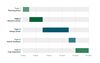
Gantt charts are visual tools useful for project management and scheduling with a timeline view of tasks, depicting the duration from start to finish.
The chart uses horizontal bars representing each task, placed along a timeline, allowing for a clear visualization of the project schedule and roadmap. It can also be updated to reflect changes in task progress.
Gantt charts find their worth in project management and for tasks that require strict adherence to timelines, where understanding the connection between different activities is crucial.
It serves as a useful tool for project managers when planning timelines, allowing resources to be allocated efficiently and ensuring key milestones are met.
Should the team encounter a roadblock, the dynamic nature of this technique also allows for changes in timelines, making it a valuable tool for controlling the execution of projects, even in the world of remote work.
PERT diagrams

Program evaluation and review technique (PERT) diagrams are project management tools used to schedule, organize and coordinate tasks within a project. They represent tasks as points connected by arrows to show task flow, with time values to aid in estimating project completion time.
PERT diagrams are beneficial for large-scale projects with uncertain timeframes and parallel activities that require coordination.
Often used in industries such as construction and IT, PERT diagrams help project managers analyze critical paths, allocate resources efficiently and identify potential delays that could impact project timelines.
Advantages of business process modeling in an organization
Business process modeling provides several benefits to organizations, such as:
Visualization of complex processes
Business process modeling uses notations and symbols to visually represent complex workflows in organizations, making them accessible and understandable for workers at all levels.
By breaking down processes into comprehensible components, it becomes easier to pinpoint bottlenecks and inefficiences.
Enhanced communication
These models serve as a universal language for both technical and non-technical personnel to overcome traditional communication barriers. This helps improve communication, reduce misunderstandings and ensure team alignment.
Resource optimization
Business process modeling analyzes workflows to identify resource utilization inefficiencies, optimizing monetary, time, manpower and technology resources.
This ensures efficient allocation, contributing to higher productivity and cost-savings.
Better decision-making
Business process modeling gives decision-makers a clear understanding of process implications by visualizing end-to-end activities.
Automation opportunities
Business process modeling identifies tasks for automation, highlighting areas where rule-based processes can be streamlined, reducing human resource burden and minimizing errors.
Choosing the right BPM tool
With the diverse range of business process modeling tools available, here are some questions to help you make an informed choice:
Does it suit your business needs?
Is it user-friendly?
Does it integrate with your tech stack?
Is it scalable?
It is cost-effective?
Popular business process modeling tools
These business process modeling tools aid in visualizing, communicating and improving business processes — all of which facilitate better decision-making and collaboration.
BPMN-based tools: Signavio and Bizagi are renowned for their comprehensive process modeling capabilities and user-friendly interface.
UML tools: Lucidchart and Enterprise Architect offer robust UML diagramming capabilities for system design and complex system modeling.
Flowchart tools: Microsoft Visio is widely used for basic process mapping due to its simplicity.
Gantt and PERT chart tools: Microsoft Project and Smartsheet are excellent for project management due to their versatility in creating Gantt and PERT charts.
Process automation tools: Hyland Automate, Hyland IDP and Hyland RPA include BPMN-based process modeling and design capabilities to enable effective process optimization.
7 steps to implement BPM
Implementing business process modeling effectively is key to reaping its benefits. Here’s a guide on integrating this technique into your business operations:
Step #1: Define objectives. Identify what your organization intends to achieve through business process modeling, whether it's improving operational efficiency, reducing costs, enhancing communication or achieving other specific goals.
Step #2: Select the right technique. Depending on the defined objectives, select a business process modeling technique that aligns with your organization’s needs.
Step #3: Train your team. Conduct training sessions or workshops to ensure that team members are well-versed in the selected business process modeling technique.
Step #4: Start with a pilot project. Implement business process modeling in a smaller project or department to assess its impact, identify potential challenges and make necessary adjustments before full-scale implementation.
Step #5: Collect feedback and iterate. Refine your approach to address any operational challenges identified in the feedback gathered.
Step #6: Roll out across the organization. Ensure that lessons learned from the pilot project are applied effectively all over the organization for a smooth transition.
Step #7: Regularly review and update. Have regular reviews to identify areas for improvement and adapt to changing business needs.
Throughout this entire process, involving the right stakeholders is also crucial for successful business process modeling implementation. Engaged stakeholders contribute valuable insights, ensure organizational buy-in and provide the necessary support for successful implementation.
Case studies for successful BPM implementations
Business process modeling can be successfully applied across different industries with specific challenges using a structured approach to analyze, optimize and implement processes. These case studies highlight the benefits of business process modeling in enhancing organizational operations:
Saving hours of administration work for a fashion company
A fashion designer company grappling with operational inefficiencies and employee frustration sought a solution from Hyland to implement a robotic process automation (RPA) solution into their existing IT set-up to get a clear representation of ongoing processes.
This approach allowed them to identify bottlenecks and redundancies, leading to the automation of various tasks across store operations, administration, accounts payable and treasury, reducing the need for human intervention.
RPA implementation led to a more efficient supply chain, saving over eight hours of daily manual administration work with more than 80% of deployed bots now working autonomously, enhancing accuracy across various operational tasks.
Hyland RPA not only addressed immediate challenges but positioned the designer for sustained success through optimized processes and increased efficiency.
Hyland RPA bots at work
Hyland RPA bots accomplished 80% of work autonomously, without human intervention and saved more than 8 hours a day in manual labor.
Improving interdepartmental collaboration for a healthcare organization
M Health Fairview, a renowned academic health system, faced the challenge of handling around 9 million patient documents annually. Manual processing led to extended turnaround times and increased workload.
Leveraging business process modeling solutions, M Health Fairview mapped out its challenges and chose Hyland Intelligent MedRecords (IMR) to automate document sorting, provide intelligent capture, extraction and validation.
The implementation offered a visual understanding of patient flow, assisting M Health Fairview in identifying and addressing areas of inefficiency. This integrated solution helped improve document processing speed and accuracy for their network of hospitals — automating the classification of 208 document types in the process.
Accelerating patient access with IDP at a patient services company
Valeris, a patient services company, leveraged intelligent document processing to streamline the enrollment process for specialty medications. By automating document separation, classification and data entry, Valeris addressed the challenges of managing high volumes of complex and mixed-document packets.
**Faster document processing:**Reduced manual processing time by up to 40%, turning tasks that once took 25-30 minutes into just 5.
**Scalability for demand spikes:**The system seamlessly handles seasonal volume surges, ensuring efficiency during peak periods like annual re-enrollments.
**Better employee experience:**By automating tedious data entry, employees focus on patient cases, improving engagement and operational productivity.
**Improved patient outcomes:**Accelerated processing times reduce delays, enabling faster access to life-saving medications.
Future trends in BPM
Embracing future trends positions organizations to drive strategic innovation, enhance customer satisfaction and foster sustainable growth through their initiatives. Here are some trends concerning business process modeling:
Integration of AI and machine learning (ML)
AI and ML technologies will empower business process modeling tools to analyze extensive datasets, predict outcomes and automate decision-making. This will make business processes more adaptable and responsive, which will lead to greater operational efficiency.
How IDP drives effective BPM

2025 Gartner® Hype Cycle™ for Artificial Intelligence Explore the future of AI and transform your enterprise with this must-read analysis on AI’s reality and potential
As AI evolves, enterprises are shifting their focus from generative AI hype to foundational innovations that drive scalable, impactful change. In this comprehensive report from Gartner, leaders get a roadmap for how to prioritize emerging AI technologies, so they can stay ahead with the right tools.
Explore key insights into the AI adoption journey, including the transition from experimental phases to scaling operations. Uncover how AI-ready data, AI governance and responsible AI implementations are becoming essential differentiators for businesses.
Increased emphasis on cloud-based solutions
The evolution of business process modeling will place greater importance on cloud-based solutions, which enable real-time collaboration among teams and rapid deployment.
Enhanced focus on customer-centric processes
Business process modeling tools will be tailored to note customer journeys, analyze feedback and quickly implement changes to enhance satisfaction. This customer-centric approach aligns with the growing importance of delivering exceptional experiences to remain competitive in the market.
Greater adoption of low-code and no-code solutions
Low-code and no-code solutions will simplify business process modeling tool interfaces, empowering nontechnical users to actively contribute to projects. This fosters collaboration, accelerates the pace of process improvements and ensures that business process modeling becomes a joint effort across different business functions.
Sustainability and compliance
Business process modeling will play a crucial role in enforcing processes that are aligned with environmental standards and regulatory requirements. Its structured approach will address the complexity of compliance, providing organizations with the tools to navigate and meet regulatory obligations effectively.
How intelligent document processing drives effective business process modeling
Integrating intelligent document processing (IDP) solutions such as Hyland IDP is a crucial step for enhancing business process modeling. While business process modeling provides the roadmap for optimizing workflows, IDP efficiently handles the fuel that drives these processes: Documents and data.
In fact, beyond streamlining document handling, Hyland IDP offers a built-in low-code BPMN designer. This allows business users and process experts to directly contribute to business process modeling initiatives and design efficient, data-driven processes without getting bogged down in technical complexities.
Let’s look at the specific ways Hyland IDP supports business process modeling efforts in organizations:
Enhanced efficiency and speed
Hyland IDP uses advanced optical character recognition (OCR) and AI-driven classification to accelerate document processing within business process modeling. This capability reduces manual effort, accelerates task completion and eliminates bottlenecks.
Improved data accuracy
Within the business process modeling framework, Hyland IDP ensures precision in data handling through intelligent character recognition and data extraction.
Integration and scalability
Hyland IDP seamlessly integrates with existing systems, a key aspect for businesses implementing business process modeling techniques to handle large document volumes. This versatility makes it a valuable tool for businesses of all sizes, ensuring the IDP solution can scale alongside evolving business needs.
The integration capabilities of Hyland IDP contribute to a smooth and cohesive workflow, enhancing the overall effectiveness of business processes.
Compliance and security
By automating the processing of sensitive information, Hyland IDP can prioritize data security and regulatory compliance. IDP technology addresses key concerns in data management by adhering to industry standards and data protection protocols.
Continuous AI-driven improvement
A standout feature of Hyland IDP is its ability to learn and adapt over time within the business process modeling process. This embodies the principle of continuous improvement as the technology evolves with usage, hence improving the document processing and classification process.
This adaptability ensures that the IDP solution remains effective and aligned with evolving business requirements, contributing to sustained process optimization.
> Read more: How AI-powered IDP is the future of intelligent enterprise
BPM as a cornerstone for efficiency and competitiveness
As businesses navigate through the difficulties of modern markets, business process modeling serves as a guide, allowing for the analysis, optimization and innovation of processes. It also demands strategic decisions, continuous refinement and a forward-thinking approach.
By embracing business process modeling as a transformative strategy, organizations can navigate the complexities of the business terrain with agility, resilience and a vision for sustained success.
Ready to get started? Chat with Hyland about IDP.

Article
The 2025 process automation guide: Setting the right priorities
The use of AI in process automation will disrupt workplaces — just make sure your organization is leading.

Article
50+ RPA use cases
Find out how RPA is being used across a range of organizations, with this list of over 50 use cases for the technology.

Article
A comprehensive guide to workflow automation
Learn the definition of workflow automation, how to implement it and how it powers increased speed, accuracy and visibility enterprise-wide.

Article
Top 10 insights from Deep Analysis’s AI and intelligent automation report
Analyst firm Deep Analysis uncovers the trends, challenges and opportunities shaping the future of AI and intelligent automation. Download the full report to unlock actionable insights that drive innovation and success in your organization.