
What is retrieval-augmented generation (RAG)?
Retrieval-augmented generation (RAG) is an AI methodology that combines the language understanding capabilities of large language models (LLMs) with real-time, external data retrieval. This approach enhances the accuracy, relevance, and contextual understanding of AI-generated responses by grounding them in updated, authoritative knowledge sources.

Forrester study: Unlocking the full potential of AI agents
Enterprise-wide AI agent adoption is accelerating
In this Hyland-commissioned study by Forrester Consulting, Forrester found that more than 45% of organizations already use AI agents and another 25% are piloting them. Although adoption is accelerating, most organizations struggle to scale beyond early use cases due to a lack of enterprise context.
Forrester provides key recommendations for how to get AI agents right, as well as detailed data on enterprise trends around agent use. Download this report to learn more about how organizations are looking to AI agents to optimize workflows, make smarter decisions and create more personalized experiences.
The difference between RAG and traditional LLMs
Traditional LLMs rely solely on their static training data, which can result in outdated or inaccurate outputs. RAG addresses this limitation by dynamically pulling relevant information from external knowledge bases, ensuring responses are consistent, grounded, and trustworthy. Designed to meet the demands of modern enterprises, RAG leverages AI to deliver more reliable business outcomes.
How RAG Works
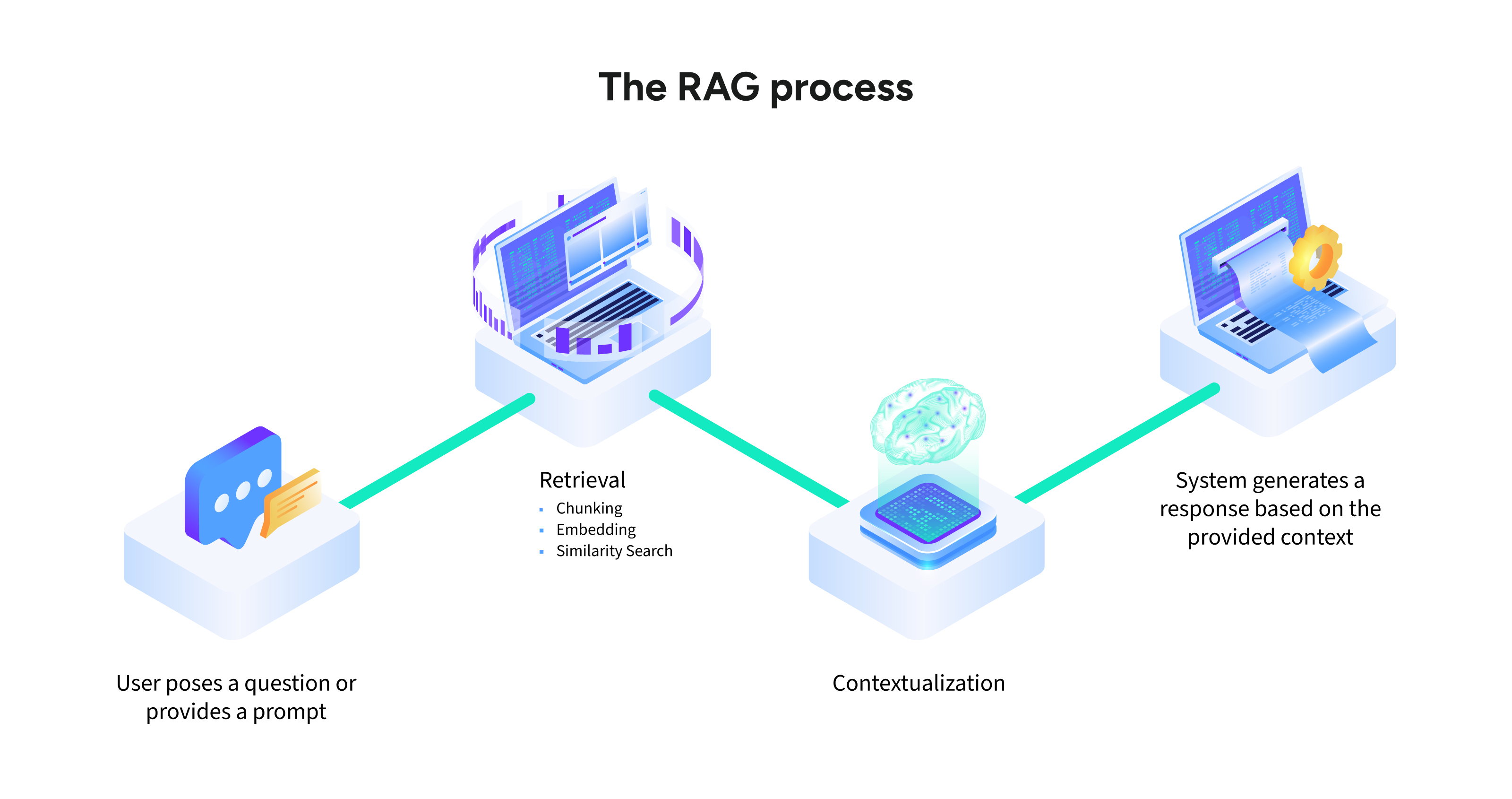
RAG operates through a well-structured process that ensures generative models provide detailed, accurate, and informed responses. Below are the key steps in a RAG framework:
Query processing
The process begins when a user submits a query or prompt. This input is analyzed and converted into a machine-readable embedding, a numerical representation of the text.
Information retrieval
The system identifies and retrieves relevant information from external sources such as databases, APIs, or document repositories. This step includes:
Chunking: Breaking large documents into smaller, manageable pieces.
Embedding matching: Converting text chunks into numerical embeddings for comparison to the user query.
Relevancy ranking: Using algorithms like semantic search to prioritize the most contextually relevant data.
Contextualization
Relevant data retrieved from external sources is appended to the original query to create a comprehensive, augmented prompt. This ensures the LLM has sufficient context to generate its response.
Response generation
The LLM processes the enriched prompt to generate a response that incorporates both the retrieved data and its pre-trained knowledge. This balanced approach ensures that outputs are specific, accurate, and relevant.
Final delivery
The response is presented to the user, often with references or links to the sources used. This transparency builds trust and provides users with deeper insights.
Tools and technologies behind RAG
Building a robust RAG system requires advanced tools and technologies, which include:
Vector databases: Platforms like Hyland Content Innovation Cloud, that support search data based on semantic similarity and accelerate the retrieval process.
Dense retrieval models: Advanced retrieval algorithms, such as dense passage retrieval (DPR), identify the most relevant information for a given query.
Development frameworks: Open- source frameworks like LangChain streamline the integration of LLMs, retrieval systems, and embedding models for RAG-powered applications.
Hardware optimization: If you want on-premises RAG, you need high-performance hardware, such as NVIDIA’s AI-accelerated chips, ensures efficient, large-scale processing in RAG systems. Alternatively, you could use an LLM provider, in which case it is possible that very little hardware would be needed, if any.
These tools empower organizations to implement scalable solutions that deliver real-time, context-aware results.

The Rise of Content Intelligence: A New Era of Innovation in ECM
In a recent survey conducted by Forrester Consulting and commissioned by Hyland, Forrester presented findings that underscore the importance of harnessing the power of enterprise content and unstructured data.
Explore their findings, which include insights on which content intelligence capabilities are ripe to flourish.
The benefits of RAG
RAG presents several advantages that elevate its effectiveness for businesses and enterprises alike:
Enhanced accuracy
Grounding LLM responses with vetted external knowledge ensures higher levels of factual consistency and reduces misinformation.
Real-time relevance
RAG enables access to current, real-world information, avoiding the stagnation that occurs with outdated LLM training data.
Cost efficiency
Unlike traditional retraining processes for AI models, RAG dynamically incorporates updated and relevant information without the need for costly fine-tuning.
Domain-specific precision
RAG supports custom integrations with industry-specific knowledge bases, enabling precise and reliable outputs tailored to niche fields like healthcare, finance, and legal industries. One of the main advantages of RAG over LLMs is the ability to retrieve knowledge from private repositories that LLMs aren’t trained on. This allows for greater precision in its responses.
Real-life applications of RAG
RAG’s adaptability makes it highly valuable across industries and use cases. Here are some examples:
Customer support
RAG-powered AI chatbots provide highly personalized answers by leveraging internal policies, FAQs, and case-specific data. They minimize wait times and enhance user satisfaction.
Read more | The power of AI in customer service
Finance
RAG supports analysts by providing real-time updates on market conditions, regulatory changes, and portfolio performance metrics. It enables them to respond more strategically in volatile markets.
Read more | Revolutionizing financial services: The impact of artificial intelligence
Content creation
From summarizing lengthy documents to creating fact-based reports, RAG facilitates efficient and accurate content generation, enabling teams to focus on higher-order tasks.
Employee enablement
Enterprise RAG systems assist staff with answers to HR questions, compliance guidelines, and training materials. This creates a self-sufficient workforce and reduces administrative overhead.
Addressing the challenges of RAG
While RAG unlocks new possibilities, it comes with challenges that require deliberate strategies to overcome:
Data reliability
Selecting authoritative knowledge sources is critical. Poor-quality data can significantly reduce the utility and reliability of responses.
Integration complexity
Implementing RAG systems often requires expertise in machine learning, semantic search, and prompt engineering, especially for large-scale deployments.
Real-time updates
Maintaining up-to-date knowledge bases and embedding vectors is essential to ensure responses are always accurate and reflect the latest information.
Mitigating hallucinations
RAG reduces instances of AI “hallucinations” (incorrect or fabricated facts), ensuring accuracy during the generation phase remains an ongoing area of optimization. It does this by implementing guardrails to remove more biases, off-topic information and mitigate any potential toxicity.
Unlock critical insights with Hyland Knowledge Discovery
Knowledge Discovery transforms how you access and use enterprise information. With AI-powered search and natural language queries, you can quickly find and verify vital data, minimizing search time and enabling faster, more informed decisions.
Key features
AI-powered search: Retrieve information with advanced search capabilities.
Custom AI agents: Using an intuitive, point-and-click interface, build AI agents to specialize in specific knowledge bases, handle repetitive queries and address business needs. Tailor agents with advanced LLM instructions and pre-set options for tone and length.
Consolidated knowledge view: Access and analyze data across platforms for a seamless, 360-degree view of your enterprise content.
Reliable validation: Quickly review sources behind AI-generated answers with direct links to original documents for added transparency.
Smarter decision support: Aggregate insights from multiple sources to streamline decision making.
Start your transformation
Eliminate silos, accelerate workflows, and make smarter decisions with Knowledge Discovery. Explore how our solutions can revolutionize your organization today.

Article
Explore the power of AI agents
AI agents are revolutionizing the way we work. These intelligent digital workers automate tasks, improve efficiency and unlock new possibilities.

Article
Navigating the pros and cons of unstructured data
Provide a brief summary of the page content (Search results page).

Article
Understanding the different types of AI agents
From simple rule-based bots to complex, collaborative systems, AI agents are transforming how organizations operate. Explore the key types of AI agents and their real-world applications in driving efficiency and intelligent automation.

Article
Powering your content with AI
Get the basics about the opportunities for infusing artificial intelligence into your content management strategy.