Understanding agentic AI architecture
Move beyond simple AI responses and discover the structural design that empowers AI agents to autonomously plan, reason and execute complex tasks in dynamic environments.

Agentic architecture is the structural design and framework for an AI system that allows one or more AI agents to operate autonomously.
Unlike nonagentic systems that provide simple, linear responses, agentic architectures support dynamic, multistep processes where agents can adapt to new information and learn from outcomes.
Architectures range from single-agent systems to complex multiagent patterns, which are being applied to transform use cases like workflow automation, customer service and enterprise intelligence.
Several core concepts define an agentic architecture and separate it from simpler AI models.
Autonomy: Agents can operate and make decisions with a significant degree of independence, without requiring constant human input for every step.
Adaptability: The system is designed to adjust its behavior and strategies in real time in response to new information or changing environmental conditions.
Goal-oriented: The architecture is built to pursue specific objectives. All planning and actions are aligned with achieving a defined end goal, rather than just executing a command.
Sense-plan-act cycle: This is the fundamental operational loop of an agent. The agent perceives its environment (senses), formulates a strategy (plans) and then carries out that strategy (acts).

Forrester study: Unlocking the full potential of AI agents
Enterprise-wide AI agent adoption is accelerating
In this Hyland-commissioned study by Forrester Consulting, Forrester found that more than 45% of organizations already use AI agents and another 25% are piloting them. Although adoption is accelerating, most organizations struggle to scale beyond early use cases due to a lack of enterprise context.
Forrester provides key recommendations for how to get AI agents right, as well as detailed data on enterprise trends around agent use. Download this report to learn more about how organizations are looking to AI agents to optimize workflows, make smarter decisions and create more personalized experiences.
Agentic architectures are typically composed of several integrated layers or components that work together to enable autonomous action.
Perception layer
This is how the agent "senses" its environment. It is responsible for gathering information through various inputs like APIs, user queries or document data.
Reasoning and planning layer
This layer processes information gathered by the perception layer, using large language models (LLMs) to understand semantics, meaning, context and goals. This capability allows the agent to reason autonomously to break down complex problems and create a strategic plan.
Unlike early AI agents that were limited by pre-programmed rules, LLM-powered agents can also reflect on their actions. By analyzing the results and feedback from the action layer, the agent can improve its performance, correct its course and adapt its strategy to achieve better outcomes.
Action layer
This is how the agent "acts" on the world. It executes the plan by using tools, calling APIs, generating text or interacting with other systems.
Memory
This component enables the agent to store and retrieve information efficiently.
Short-term memory manages data for the immediate task, maintaining the necessary focus during execution. Long-term memory builds context over time by extracting and remembering user preferences and summarizing past experiences. This allows the agent to retrieve relevant history to inform the current context, generating a positive bias that helps it successfully resolve new problems.
> Read more | Understanding the different types of AI agents
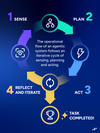
The operational flow of an agentic system follows an iterative cycle of sensing, planning and acting.
Sense
The process begins when the agent gathers data from its environment. For example, a customer service agent receives a support ticket containing unstructured text.
> Read More | Unstructured data management: Unlocking business value
Plan
The agent uses its reasoning layer to analyze the ticket and formulate a strategy for resolution. For well-defined problems, this can involve creating a complete execution plan with a sequence of sub-tasks, such as identifying the product issue and then searching the knowledge base.
Alternatively, to allow for greater autonomy and flexibility, the agent may focus only on determining the single next best action. After executing that step, it senses the outcome and re-evaluates its plan, adapting its approach based on the new information it receives.
Act
Next, the agent executes the plan using its tools. This process is often governed by modern frameworks like the Model Context Protocol (MCP), which enables the agent to select the right tool and correctly structure its command. For example, it might call a database API to search the knowledge base, then use its text generation capability to draft a reply.
Reflect and iterate
The cycle does not end with action. The agent can then reflect on the outcome. If the knowledge base search returns no results, it can adapt its plan — perhaps by rephrasing the query or deciding to escalate to a human. This iterative loop is what makes the architecture truly agentic.
Agentic vs. nonagentic architecture: From static responses to dynamic action
The distinction between agentic and non-agentic systems lies in their fundamental design and capabilities. A nonagentic architecture enables a linear, "single-shot" process where an input is given to an LLM and a static output is generated. It is suitable for known, well-defined tasks but cannot perform multi-step actions without being reprompted for each step.
The key limitation is its lack of autonomy. While feedback loops can be engineered to create more complex workflows, this results in a sophisticated process, not an autonomous entity. The system lacks the agency to adapt or be flexible, and its performance will always be limited by how that process was originally modeled.
In contrast, an agentic architecture supports an autonomous process. The agent can make multiple decisions, use various tools, and self-correct within a single request to achieve a complex goal, making it essential for dynamic tasks like workflow automation or interactive problem-solving.
> Read more | AI agents vs AI assistants vs agentic AI

2025 Gartner® Hype Cycle™ for Artificial Intelligence
Explore the future of AI and transform your enterprise with this must-read analysis on AI’s reality and potential
As AI evolves, enterprises are shifting their focus from generative AI hype to foundational innovations that drive scalable, impactful change. In this comprehensive report from Gartner, leaders get a roadmap for how to prioritize emerging AI technologies, so they can stay ahead with the right tools.
Explore key insights into the AI adoption journey, including the transition from experimental phases to scaling operations. Uncover how AI-ready data, AI governance and responsible AI implementations are becoming essential differentiators for businesses.
The complexity and design of an agentic architecture depend on the task it needs to perform.
Single-agent vs. multiagent systems
A single-agent architecture features one autonomous agent making centralized decisions, which is best for focused, self-contained problems.
A multiagent architecture involves multiple agents collaborating to solve a problem, which is better for complex challenges requiring diverse expertise.
> Read more | Understand the potential of AI agents
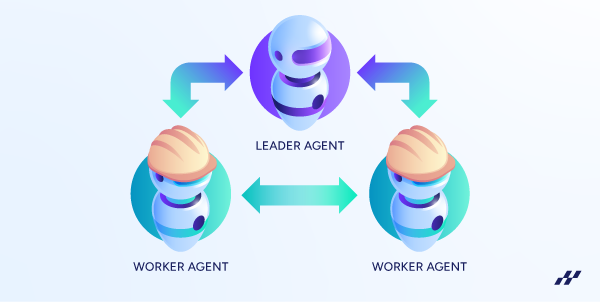
Vertical (hierarchical) architecture: A "leader" agent oversees and delegates subtasks to specialized "worker" agents. This is efficient for sequential workflows with clear accountability.
> Read more | Streamline automation with agentic AI
Horizontal (collaborative) architecture: A decentralized model where agents work as peers, sharing information and making decisions collectively. This is ideal for brainstorming or complex problem-solving.
Hybrid architecture: This model combines both vertical and horizontal structures, offering a balance of structured oversight and creative flexibility.

Harvard Business Review Analytic Services pulse survey insights: Going beyond traditional AI and toward agentic AI
Many organizations find themselves unprepared to harness the full potential of AI. This pulse survey from Harvard Business Review Analytic Services reveals that while 94% of leaders recognize the importance of well-connected data for AI success, only 27% have achieved it.
In “Bridging the Readiness Gap to the Agentic Enterprise,” learn about strategies for fully connecting your content and how leading enterprises are thinking about transforming unstructured content into connected pipelines.
Building a robust agentic architecture requires careful consideration of several key design principles.
Determine the decision-making logic
Decide if the agent needs simple rule-based logic, probabilistic reasoning from an LLM, or reinforcement learning to improve over time.
> Read More | How AI decision-making transforms enterprise operations
Define memory requirements
Determine if the agent will be stateless for transactional tasks or if it needs to remember past interactions using short-term state or long-term databases.
Plan for tool integration
Define how the agent will interact with the outside world, whether with a fixed set of tools or the ability to dynamically select tools based on the task.
Manage the solution space
For complex tasks, use domain-specific rules or heuristics to guide the agent and prevent it from getting stuck in inefficient loops.
> Read More | What is agentic automation?
Establish human supervision
Designing an effective agentic architecture involves balancing agent autonomy with human oversight.
For high-stakes or sensitive tasks, you can build in checkpoints where a human must approve an agent’s plan before it proceeds. For low-risk processes, agents can be granted full autonomy. A hybrid approach is also possible, where an agent operates independently unless its confidence in an outcome falls below a certain threshold, at which point it escalates for human review.
Agentic architectures are being deployed to solve real-world business challenges and unlock new opportunities for automation and intelligence.
Complex workflow automation
These systems can automate multi-step business processes like invoice approvals or employee onboarding, where an agent must interact with multiple systems like an HRIS, ERP and email.
Advanced customer service
An agentic system can handle an entire customer issue, from understanding the initial query to searching knowledge bases, interacting with order systems and escalating to a human agent with a complete summary.
Enterprise intelligence and research
Agents can perform deep research tasks by scouring internal databases and external sources, synthesizing information, identifying trends and generating detailed reports.
Autonomous IT operations
A cybersecurity agent can monitor network traffic, detect a threat, plan a mitigation strategy like isolating a server and execute it, all while documenting its actions for an audit trail.
Hyland’s approach focuses on solving complex, content-based problems. To succeed, agents must navigate and understand vast amounts of structured and unstructured information, such as contracts, reports and customer emails. Understanding this content in its full business context is what enables agents to make the best decisions.

The Aragon Research Globe™ for Intelligent Enterprise Content Management, 2025
The age of AI is transforming enterprise content. Are you ready?
Content is no longer just an archive — it’s a strategic asset. As AI accelerates, legacy content repositories are becoming a liability, while modern platforms are unlocking new value through intelligent automation and Content AI.
Learn why Aragon identified Hyland as a Leader, including calling out our agentic AI capabilities, visionary efforts and transformative roadmap.
Solution highlight: Hyland Enterprise Agent Mesh
Enterprise Agent Mesh is a new technology embedded inside Hyland Content Innovation Cloud™. It provides the framework for Hyland, our partners and our customers to build and deploy multiagent networks. These networks can solve complex use cases, combining background process automation with user interaction and collaboration.
The foundation for this network is Hyland Enterprise Context Engine, a new-to-the-market solution that delivers a unified, dynamic perspective on organizational operations. It serves as a living record of enterprise activity by seamlessly linking content, processes, people and applications across systems like ERPs and CRMs.
Together, Enterprise Agent Mesh and Enterprise Context Engine help organizations retain and scale institutional knowledge. That knowledge is continuously refined through human feedback, fostering a powerful human-AI collaboration that makes the entire enterprise more intelligent.
Building agentic architectures with Hyland Agent Builder
With Agent Builder, you have a core tool for designing, deploying and managing the powerful agentic architectures that drive modern automation. Agent Builder enables organizations to design and manage enterprise-grade AI agents (enterprise agents) that automate complex tasks. These enterprise agents can be embedded in workflows within Hyland Automate, Hyland ECM products and other third-party tools.
With a point-and-click solution builder, business process experts — not just developers — can build and deploy agents, accelerating innovation. Users can define an agent's goals, provide it with knowledge resources and specify the actions it can take, directly enabling the creation of custom single-agent and multi-agent systems. The platform also provides comprehensive agent lifecycle management, allowing users to version, test, monitor and improve agents continuously to meet evolving business needs.
Hyland Content Innovation Cloud™
The platform to power content innovation
Content Innovation Cloud is the future of enterprise content management. By leveraging a unified content, process and application intelligence platform, your organization can unlock profound insights from enterprise content and unstructured data — fueling innovation without disruption.

Article
Elevating experiences: The power of AI in customer service
Learn how AI-driven solutions are transforming customer service and helping organizations deliver personalized, efficient and effective interactions with customers.

Article
How AI Agents are driving smarter business decisions
AI agents for business are transforming industries by improving decision-making and operational outcomes. Designed for scalability, they unlock powerful insights and elevate your organization's competitive edge.