How AI agents are driving smarter business decisions
AI agents for business are transforming industries by improving decision-making and operational outcomes. Designed for scalability, they unlock powerful insights and elevate your organization's competitive edge.

Summary
AI agents are transforming decision-making by offering businesses tools to act smarter, faster, and more strategically. These autonomous systems analyze data, optimize operations, take necessary actions and enable better choices.
Through improved predictability, risk assessment, resource prioritization, and scenario planning, AI agents empower organizations to adapt, stay competitive and achieve measurable outcomes.

The Rise of Content Intelligence — A New Era of Innovation in ECM
Insights from the 6th Annual Content Services Pulse Study, 2025 Edition
Explore how modern content services solutions unlock content intelligence to streamline workflows, strengthen governance and drive better business outcomes. Get practical insights on AI readiness, content intelligence adoption and workforce transition strategies.
How AI Agents are driving smarter business decisions
AI agents give businesses a significant edge by optimizing processes and providing insights that lead to better decisions. Companies are increasingly cognizant of the potential of AI agents, with 82% of companies planning to integrate them within their business within the next one to three years. Here’s a deeper look at the specific ways they support business operations:
Improved predictability
AI agents analyze historical trends and current data to make predictions. For example, a retail company can use AI agents to identify purchasing behaviors across seasons. The software could then predict an increase in demand for winter coats based on previous years, weather forecasts and online shopping trends. This helps businesses stock inventory accordingly, minimizing overstocks or shortages.
> Read more | Explore the power of AI agents
Better risk assessment
These systems process intricate datasets to flag potential vulnerabilities, such as supply chain disruptions or cybersecurity threats. For instance, an AI agent in the transportation industry could predict delays by analyzing traffic patterns, weather reports and maintenance logs. Identifying routes that frequently experience delays enables companies to reroute shipments and ensure on-time deliveries.
More efficient resource prioritization
AI agents could be used to assess possible projects or tasks, predicting which will deliver the best outcomes. A construction company might use AI agents to prioritize resource allocation, determining that deploying a larger than usual workforce to high-value projects, such as client-requested customizations, will yield higher customer satisfaction and profitability.
More in-depth scenario planning
AI agents could help businesses prepare by simulating potential events and outcomes. For example, a financial institution might run "what if" scenarios using AI to test the impact of interest rate changes on lending strategies. With multiple scenarios analyzed, decision-makers can craft flexible policies that guide their approach regardless of economic shifts.
More accurate cost-benefit analysis
AI agents rigorously evaluate financial implications, helping businesses weigh potential actions. An AI-powered system for a manufacturing company may determine whether investing in automation will deliver savings in labor costs over a five-year span. By balancing upfront investment with long-term efficiencies, these analyses steer budget-friendly decisions.
> Read more | How to reduce operating costs

Forrester study: Unlocking the full potential of AI agents
Enterprise-wide AI agent adoption is accelerating
In this Hyland-commissioned study by Forrester Consulting, Forrester found that more than 45% of organizations already use AI agents and another 25% are piloting them. Although adoption is accelerating, most organizations struggle to scale beyond early use cases due to a lack of enterprise context.
Forrester provides key recommendations for how to get AI agents right, as well as detailed data on enterprise trends around agent use. Download this report to learn more about how organizations are looking to AI agents to optimize workflows, make smarter decisions and create more personalized experiences.
How AI agents support strategic goals
AI agents not only address operational needs but also empower businesses to execute more strategically. These tools offer adaptability and insight that help organizations thrive in a competitive landscape.
Supporting organizational objectives
AI agents streamline workflows to free up teams for mission-critical goals. For example, a healthcare organization could use AI to automate administrative tasks like patient scheduling and eligibility verification.
Clinicians then focus more on patient care, enhancing outcomes and aligning with the larger objective of excellent patient experience.
Driving financial performance
Through efficiency and insight, AI agents reduce waste and increase returns. An ecommerce business deploying AI can personalize recommendations based on browsing history. This might lead to higher conversion rates because customers are shown products they’re most likely to buy, directly boosting sales revenue.
Improved competitive edge
Businesses that leverage AI can respond faster to trends, keeping them ahead of competitors. For example, a travel agency using AI might detect rising interest in ecotourism by analyzing social media conversations and booking habits. By creating tailored packages before others, the agency solidifies its position as an industry leader in sustainability-focused travel.
Adaptability to change
AI agents enable businesses to react dynamically to shifting environments. For instance, amid global supply chain disruptions, an AI system could recommend alternative suppliers, ensuring continuous operation. It could calculate the costs and delivery times of multiple suppliers, providing options best suited to the business’ needs.
Creating measurable value
AI agents focus on impactful initiatives that drive business growth. A logistics company utilizing AI could optimize its fleet operations, resulting in lowered fuel costs and reduced emissions. Over time, these savings contribute to both profitability and environmental sustainability, increasing overall value.
Build AI agents with a point-and-click interface
Hyland Agent Builder empowers you to efficiently design, deploy and manage AI agents, so you can automate complex workflows with ease while maintaining control through human oversight.
Build your agentic workforce from the ground up or choose from a catalog of prebuilt agents, then manage the entire lifecycle to align with your evolving business needs
Implementing AI agents responsibly
For AI agents to deliver their full potential, businesses must ensure the technology is deployed responsibly. This involves maintaining transparent processes, rigorous oversight and high-quality data inputs. Ethical considerations, such as addressing biases in AI algorithms, also play a crucial role in effective implementation. With these measures in place, organizations can unlock impactful insights while preserving trust and integrity.
Redefining decision-making in today’s world
AI agents have revolutionized decision-making, offering unprecedented levels of precision and efficiency to businesses across industries. By enhancing predictability, mitigating risks, and fostering adaptability, these tools empower organizations to take confident, data-driven steps toward sustained success in a rapidly changing world.
> Read More | How AI decision-making transforms enterprise operations
Unlocking the potential of AI agents
To maximize the value of AI agents, organizations must ensure ethical and strategic implementation. This includes maintaining high-quality data for analysis, providing oversight for AI-driven decisions, and fostering transparency to build trust. While challenges exist, businesses that successfully integrate AI agents can unlock innovations that create incredible outcomes for customers and stakeholders alike.

Harvard Business Review Analytic Services pulse survey insights: Going beyond traditional AI and toward agentic AI
Many organizations find themselves unprepared to harness the full potential of AI. This pulse survey from Harvard Business Review Analytic Services reveals that while 94% of leaders recognize the importance of well-connected data for AI success, only 27% have achieved it.
In “Bridging the Readiness Gap to the Agentic Enterprise,” learn about strategies for fully connecting your content and how leading enterprises are thinking about transforming unstructured content into connected pipelines.
Use cases for AI agents in business
AI agents provide valuable solutions to challenges across various industries, helping optimize operations and enhance outcomes.
Healthcare
Hospitals use AI to manage staff schedules, evaluate correspondence, checking information against policy to aid decision making, and bed allocation during busy times.
> Read this HIMSS report | Navigating the complexities of AI and machine learning in healthcare
Retail
AI personalizes shopping experiences by analyzing consumer habits. Ai agents could enable e-commerce platforms to recommend products, or help stores optimize inventory to meet demand during sales.
> Read more | The power of AI in customer service
Manufacturing
By monitoring equipment with AI, manufacturers can predict breakdowns, minimizing downtime and saving costs.
Finance
Financial institutions leverage AI to detect fraud in real time and automate processes like loan approvals for faster, accurate decisions.
> Read more | Revolutionizing financial services: The impact of artificial intelligence
Education
AI customizes learning with courses tailored to student needs, while automating administrative tasks to free up educators’ time.
> Read more | The role of AI in transforming higher education
Transportation and logistics
AI optimizes delivery routes based on traffic and weather, helping courier services save on time and costs while improving reliability.
Energy
AI forecasts energy demand for better resource management. Renewable energy providers use AI to balance solar or wind output with consumption.
Hospitality
Hotels enhance guest experiences by using AI to tailor services and automate dynamic pricing strategies that boost revenue.
> Read more | Understanding the different types of AI agents

How Hyland Content Intelligence empowers AI-driven decisions
Hyland’s Content Intelligence solutions help organizations leverage their enterprise content to effectively scale AI. By transforming content and unstructured data into structured and enriched AI-ready assets, Content Intelligence enables next-level data curation, knowledge discovery, automation and solution-building to accelerate decisions and processes, boost productivity and efficiency, and unlock the full potential of their content.
Hyland Knowledge Enrichment: Organize unstructured data into AI-ready structured formats, enhancing workflows and supporting advanced AI applications.
Hyland Knowledge Discovery: Quickly access insights from diverse content using natural language and tailored AI agents for faster decision-making. Hyland leverages AI agents and retrieval-augmented generation to streamline complex searches.
Hyland Agent Builder: Enables the creation, configuration, and management of AI agents for multiagent collaboration, scaling AI across the organization.
Hyland IDP: delivers AI-powered agentic document processing.
Hyland Automate: Enables organizations to transform their operations with the power of AI.
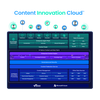
Hyland Content Innovation Cloud™
The platform to power content innovation
Content Innovation Cloud is the future of enterprise content management. By leveraging a unified content, process and application intelligence platform, your organization can unlock profound insights from enterprise content and unstructured data — fueling innovation without disruption.

Article
Use AI to redefine content management with Hyland
The tools that redefining content management with AI

Article
AI skills gap: Strategies for a future-ready workforce
Discover targeted strategies that help bridge the AI skills gap and equip your workforce with the necessary skills to thrive in an AI-everywhere world.

Article
Automated intelligence vs. artificial intelligence: What’s the difference?
Today’s technologies pack a lot of similar words and complicated nuances into their meanings. Learn the differences between automated intelligence and AI.

Article
Before you invest in AI, assess your AI-readiness
The promise and potential of AI is something every organization wants to align with, but one big part of its implementation is often overlooked: AI-readiness. Before AI can achieve what you expect it to, your enterprise content must be AI-enabled. Here's the AI-readiness framework to consider.