How AI decision-making transforms enterprise operations
Driving strategic advantage with AI decision making.

Summary
AI decision-making harnesses artificial intelligence to analyse massive datasets, providing data-driven recommendations that augment human expertise.
Core challenge: Enterprises face slow, inefficient operations caused by data silos and content overload. AI accelerates business by automating complex analysis.
Key capabilities: AI platforms process vast unstructured data from hundreds of file formats, identify deep patterns and provide enhanced insights to support human judgment.
Strategic value: Integrating AI into decision workflows fuels productivity, improves consistency and lowers operational risk.
Business outcome: This integration drives significant new revenue opportunities and a stronger competitive position.
The business case for AI decisioning
AI systems process complex data instantly to deliver enhanced insights, fueling unprecedented productivity gains across your operations. Instead of burning budget on manual data sorting, your teams can execute high-value strategic initiatives that drive revenue growth and secure market dominance. Companies that take advantage of ai decisioning will push forward, while those that don’t will fall behind.
A McKinsey Global Survey found that only 20% of organizations believe they excel at decision-making. For those trapped in decision paralysis and data overload, this inefficiency costs Fortune 500 companies an estimated $250 million in wasted labor every year.
By adopting agentic automation and AI decisioning, enterprises transform these massive labor costs into a direct ROI boost.

Forrester study: Unlocking the full potential of AI agents
Enterprise-wide AI agent adoption is accelerating
In this Hyland-commissioned study by Forrester Consulting, Forrester found that more than 45% of organizations already use AI agents and another 25% are piloting them. Although adoption is accelerating, most organizations struggle to scale beyond early use cases due to a lack of enterprise context.
Forrester provides key recommendations for how to get AI agents right, as well as detailed data on enterprise trends around agent use. Download this report to learn more about how organizations are looking to AI agents to optimize workflows, make smarter decisions and create more personalized experiences.
The strategic benefits of agentic automation and decisioning
Integrating AI into your core operations yields tangible improvements in productivity, data validation and risk management.
Accelerated productivity and throughput
AI systems automate time-consuming data analysis and repetitive tasks. They operate continuously to unburden employees from repetitive work, allowing them to focus on higher-value, strategic initiatives. Research from an MIT challenge shows AI assistance helps filter out weaker ideas, allowing human evaluators to focus their energy on the most promising solutions.
> Read more | Measuring and improving operational efficiency
Enhanced data validation and risk mitigation
AI algorithms identify complex patterns and correlations in vast datasets that humans frequently overlook. This leads to more robust, reliable insights and predictions. By analysing historical data and running simulations, AI gives decision-makers a comprehensive view to inform their choices. One example of this comes from healthcare, where a deep-learning sepsis alert system at Johns Hopkins was able to detect 82% of sepsis cases.
Lowered operational risk and error reduction
AI-powered systems proactively identify and mitigate risks by detecting patterns that indicate fraud, market volatility or supply chain disruptions. A key part of responsible AI is building in governance from the start. AI-powered governance can identify retention policy issues and flag compliance gaps, using human-in-the-loop checkpoints for verification.

Harvard Business Review Analytic Services pulse survey insights: Going beyond traditional AI and toward agentic AI
Many organizations find themselves unprepared to harness the full potential of AI. This pulse survey from Harvard Business Review Analytic Services reveals that while 94% of leaders recognize the importance of well-connected data for AI success, only 27% have achieved it.
In “Bridging the Readiness Gap to the Agentic Enterprise,” learn about strategies for fully connecting your content and how leading enterprises are thinking about transforming unstructured content into connected pipelines.
How agentic AI decision-making works
The process begins by ingesting and processing massive volumes of structured and unstructured data, including text, images and sensor readings. Turning large volumes of relevant data into structured, referenceable information allows enterprise AI to operate with the benefit of contextually and historically accurate institutional knowledge.
Modern platforms use knowledge enrichment to transform unstructured content from over 600 file formats into structured, AI-ready data. This clean data then fuels AI agents and analytics platforms, so you can derive enhanced insights from your entire content library.
> Read more | What you can do with Hyland Knowledge Enrichment?
The progression of AI decision-making
Not all AI decision-making is the same. McKinsey defines six stages of AI-for-strategy, showing a clear progression from simple support to full autonomy.
Most organizations currently operate in the first three levels, which are widely available today:
Level 1: Simple analytics (data science)
Level 2: Diagnostic intelligence (why something happened)
Level 3: Predictive intelligence (what will happen)
The next three levels are still in development but represent the future of strategic automation:
Level 4: AI advising actions
Level 5: Delegating decisions to AI with supervision
Level 6: Fully autonomous AI
Navigating the risks of AI decision-making
Deploying AI at scale requires a clear-eyed approach to organizational risk. While the potential for enhanced decisioning is immense, the challenges of over-reliance, poor data integrity and algorithmic bias must be addressed through robust governance. Implementing the right oversight framework ensures that AI remains an engine for growth rather than a source of liability.
The danger of automation complacency
Research identifies a "human oversight paradox" where AI-generated explanations can ironically increase a user's tendency to follow recommendations without critical evaluation. When AI provides a clear rationale for a decision, it often builds an aura of reliability that encourages "rubber-stamping," even when the output requires expert scrutiny. To mitigate this, organizations must mandate human-in-the-loop checkpoints that treat AI output as an advisor rather than an infallible authority.
The cost of poor data quality
The efficacy of any AI system is strictly tied to the quality of its underlying information. Gartner reports that businesses waste an average of $15 million annually due to decisions based on flawed or fragmented data. When inputs are inconsistent or trapped in silos, AI models cannot produce reliable insights. Organizations must prioritize the transformation of unstructured content into clean, structured, AI-ready data before deploying autonomous decisioning tools.
> Read More | Prove AI ROI by fixing the context gap
Managing algorithmic bias
AI models are only as objective as the data they ingest. If historical data contains latent biases, the system will often amplify them, leading to inequitable or distorted outcomes. Organizations must implement continuous monitoring and clear confidence thresholds, ensuring that human judgment remains the final filter to correct for systemic algorithmic flaws.
The role of human oversight in AI systems
Research confirms human intuition remains superior for subjective judgment, while AI excels at objective assessment based on clear metrics.
The most effective model is a collaborative system where human experts critically evaluate AI suggestions rather than accepting them at face value. AI should augment, not replace, human intelligence. Scalable supervision through human-in-the-loop actions is critical, enabling you to set confidence thresholds and require human validation for AI-generated outputs, especially in high-stakes environments.
Enterprise use cases for AI decisioning
True AI-driven decisioning moves beyond basic task automation by applying intelligent logic to complex, unstructured workflows. These use cases illustrate how organizations leverage autonomous decision-making to evaluate data, apply business rules and execute high-value business actions.
Insurance: Automated claims determination
Insurance carriers often struggle with high-volume, low-complexity claims that require significant manual review to determine coverage eligibility. By deploying agentic AI, carriers can now ingest claim documentation and policy schedules to automatically compare the two.
The AI agent evaluates the data against specific policy parameters to recommend a decision (such as pay, deny or route for specialized human review) based on preset confidence thresholds. This significantly reduces the time-to-settlement while ensuring consistent policy application.
> Read more | Insurers say hello to generative AI’s new partner, agentic AI
Financial services: intelligent KYC compliance assessment
Know Your Customer (KYC) processes are traditionally fragmented, requiring analysts to manually cross-reference identities, regulatory watchlists and business documentation. Agentic platforms automate this by orchestrating the extraction of entity data and comparing it against real-time global compliance databases. Instead of a human manually flagging potential risks, the AI agent interprets discrepancies in the data and makes an initial determination on risk profiles, escalating only high-risk exceptions for human investigation.
> Read more | The impact of AI on financial services
Healthcare: intelligent revenue cycle correspondence
Revenue cycle slowdowns often stem from the need to interpret and route inbound patient or payer correspondence, which is frequently unstructured and context-heavy. By applying generative AI to these communications, healthcare organizations can now automatically classify the intent—whether it is a billing inquiry, a medical record request or an authorization update.
The AI does not just sort the document; it interprets the content to determine the correct downstream workflow, proactively drafting potential responses or updating the patient’s financial record based on the communication's intent.
> Read more | Unstructured data in healthcare: The missing link to interoperability
Government: automated eligibility determination
Public sector agencies managing social programs must process massive volumes of applications, where determining eligibility is often a complex, multivariable task. Using agentic decisioning, agencies can automatically validate applicant information against disparate datasets and policy rules to determine initial program eligibility.
The AI agent flags missing information or conflicting data points and applies the logic required to approve or deny requests that meet clear thresholds, allowing case workers to dedicate their time to complex eligibility exceptions.
> Read more | Why agentic AI can be a game-changer for government agencies

Subscribe to The Shift
Hyland’s monthly newsletter helps you elevate your content management strategy
Offering unparalleled insights into the AI and cloud technologies transforming what content can do, The Shift gives you actionable strategies from industry thought leaders. Learn from real-world success stories and innovative perspectives that will keep your organization at the forefront of ECM transformation.
Subscribe to stay ahead, stay informed and make your enterprise content an even more strategic asset.
How to implement AI-enhanced decisioning
The primary requirement for successful implementation remains the construction of a robust, content-centric foundation.
Start with data: AI capability remains strictly limited by the quality of the information it processes. You must first prioritize the transformation of your enterprise content into clean, structured, AI-ready assets.
Prioritize a human-centered design: Focus on a "Think Big, Start Small" strategy, placing people at the center of the workflow design. Equip users with the knowledge necessary to build confidence, ensuring they remain the primary decision-makers.
Focus on trust, access and integration: Build confidence with explainable AI, democratize access with user-friendly tools and seamlessly embed AI decisioning into existing workflows.
"With gen AI, we can now give structure to what was previously unstructured. We can read — literally read and process — all of the petabytes of content and images, interpret them, and enable organizations to understand what’s inside them and drive greater automation."
How Hyland fuels AI decision-making
Hyland provides a comprehensive platform to help you integrate AI into your core operations.
AI-ready foundation: Hyland starts by making your content AI-ready. AI-powered IDP and Knowledge Enrichment transform unstructured data from over 600 file types into clean, structured information to fuel reliable AI.
Accelerated decisions: Hyland Knowledge Discovery provides decision support by allowing users to ask natural language questions across all enterprise content. You get fast, aggregated answers with links to source documents for verification.
Agentic automation: The AI-native Hyland Content Innovation Cloud™ enables the creation of enterprise agents with Hyland Agent Builder. These agents work within Hyland Enterprise Agent Mesh, powered by Hyland Enterprise Context Engine, to automate complex, end-to-end decision workflows with full business context.
Governance and trust: Hyland ensures responsible AI through an LLM-agnostic architecture. It features customizable guardrails, built-in human-in-the-loop checkpoints and robust data privacy controls that secure information and prevent data leakage.
Initiate your intelligent automation strategy
Hyland’s Content Innovation Cloud provides the essential framework for enterprises to adopt AI decision-making with confidence. By creating an AI-ready data foundation, Hyland fuels ubiquitous intelligence and automation. The Enterprise Context Engine and Enterprise Agent Mesh enable organizations to automate complex workflows and make faster, smarter decisions. This is all accomplished within a platform built on responsible AI principles, ensuring that as you innovate, your data remains secure, governed and trustworthy.
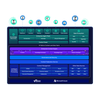
Hyland Content Innovation Cloud™
The platform to power content innovation
Content Innovation Cloud is the future of enterprise content management. By leveraging a unified content, process and application intelligence platform, your organization can unlock profound insights from enterprise content and unstructured data — fueling innovation without disruption.

Article
AI agents, AI assistants and agentic AI
AI agents are proactive, achieving goals autonomously. AI assistants react to commands, performing defined tasks.

Article
Business benefits of retrieval-augmented generation
Retrieval-augmented generation redefines how businesses harness information, merging AI capabilities with authoritative data to drive accuracy and innovation

Article
Understanding the different types of AI agents
From simple rule-based bots to complex, collaborative systems, AI agents are transforming how organizations operate. Explore the key types of AI agents and their real-world applications in driving efficiency and intelligent automation.

Article
How AI Agents are driving smarter business decisions
AI agents for business are transforming industries by improving decision-making and operational outcomes. Designed for scalability, they unlock powerful insights and elevate your organization's competitive edge.