What is agentic AI automation, and how does it accelerate business?
Transition from task-based automation to goal-oriented enterprise systems that can reason, plan and act autonomously to achieve business outcomes.

Summary
Agentic automation uses autonomous AI agents to achieve end-to-end business goals.
Challenge and solution: It overcomes the limits of traditional automation by deploying goal-centric AI agents that handle unstructured workflows and adapt to changing conditions, so you can accelerate business outcomes.
Key capabilities: You can leverage AI agents that use advanced frameworks to reason through problems, orchestrate complex tasks across systems and self-correct when issues arise.
Strategic value: It drives faster cycle times and a lower total cost of ownership. It also helps you scale operations by automating end-to-end processes that previously required significant human coordination.
The shift from task-based bots to agentic automation
Agentic automation is a strategic shift from process-centric automation to goal-centric execution. Instead of programming a bot to follow a rigid script, you give an autonomous AI agent an objective. The agent can reason, plan and act independently to achieve its goal.
This marks a fundamental evolution from both traditional robotic process automation (RPA) and intelligent automation (IA).
RPA operates as a high-speed assembly line worker, executing predefined, static scripts rapidly.
IA elevates this by integrating machine learning to process more complex data, yet it still relies on rigid "if-then" logic.
Agentic AI acts as a digital employee. It mimics human thought and coordination, managing the complex reality of modern business where progress depends on context and cross-team communication.
Distinguishing agentic process automation from robotic process automation and intelligent automation
The question for enterprise architects is no longer just about speed. It is about resilience, adaptability and scope.
Feature | RPA | IA | Agentic process automation |
Logic & execution | Executes predefined, static scripts | Follows predefined "if-then" logic | Uses context-aware reasoning and planning |
Adaptability | Breaks when a user interface changes | Requires manual updates for new variables | Learns and adapts to new environments autonomously |
Data handling | Requires structured, clean inputs | Processes complex but structured data | Processes unstructured text, images and voice |
Goal & scope | Completes specific tasks (e.g., data entry) | Enhances specific process segments | Achieves end-to-end outcomes (e.g., resolving a customer dispute) |
Error handling | Flags errors for manual IT intervention | Flags exceptions for human review | Self-corrects or attempts alternative strategies to keep processes moving |
By transitioning to agentic frameworks, technology leaders can eliminate the brittle scripts that cause workflow exceptions and bottlenecks and instead deploy resilient systems capable of owning entire business processes from start to finish.
> Read more | AI agents, AI assistants and agentic AI
Investing in artificial intelligence for growth, efficiency and competitiveness isn't a leap of faith anymore, but a strategic necessity for businesses.
The business benefits of agentic process automation
Agentic AI moves beyond simple task completion. It is built to achieve business outcomes by coordinating multiple systems and bridging data silos.
Faster cycle times and reduced overhead
Agentic systems significantly reduce manual administrative overhead by automating document validation, routing, follow-ups and monitoring. Organizations using a hybrid human-AI model report massive reductions in process cycle times by removing these manual friction points.
> Read more | How to improve operational efficiency
Reducing operational delays with autonomous agents
Manual friction in end-to-end workflows often stalls progress and drives up costs. Agentic automation eliminates these bottlenecks by deploying agents capable of reasoning through complex tasks without human hand-offs. In a vendor dispute scenario, an autonomous agent can analyze the conflict, validate historical data and execute the correction. This accelerates business cycles and provides a clear audit trail for every action taken.
Reduced total cost of ownership (TCO)
Agentic systems are highly resilient to changes in user interfaces or process steps, which eliminates the high maintenance costs associated with brittle RPA scripts. Advanced frameworks offer high observability with visual traces, reducing the mean-time-to-resolution (MTTR) for technical issues and directly lowering operational overhead.

2025 Gartner® Hype Cycle™ for Artificial Intelligence
Explore the future of AI and transform your enterprise with this must-read analysis on AI’s reality and potential
As AI evolves, enterprises are shifting their focus from generative AI hype to foundational innovations that drive scalable, impactful change. In this comprehensive report from Gartner, leaders get a roadmap for how to prioritize emerging AI technologies.
Driving business value with the three-layer framework of agency
Modern agentic frameworks give AI the ability to take action through a three-part architectural loop:
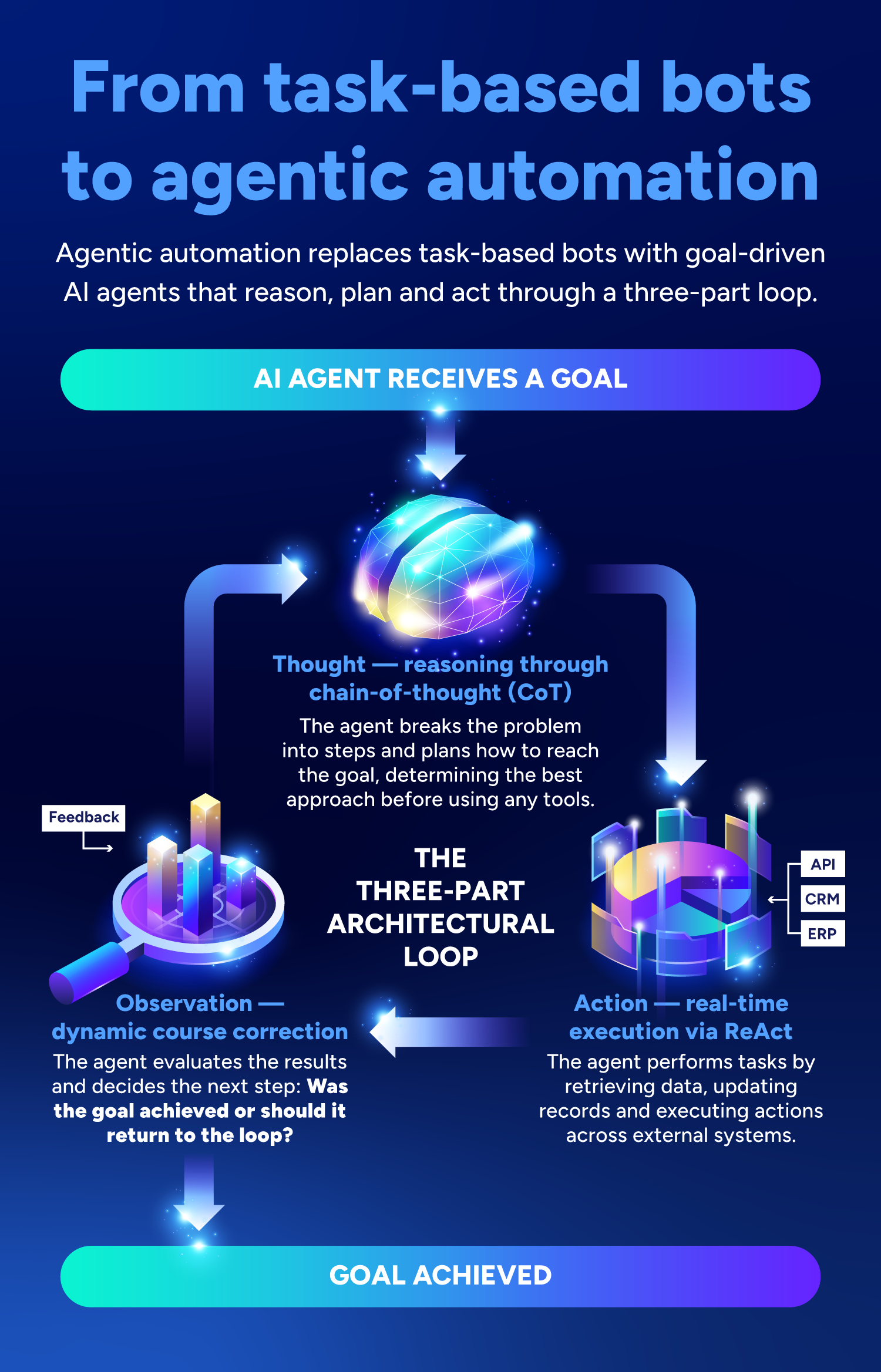
This structure ensures every automated step is grounded in logical reasoning rather than blind execution, reducing the risk of costly production errors.
Layer 1: Thought — reasoning through chain-of-thought (CoT)
Chain-of-thought (CoT) is a reasoning technique where an agent breaks a complex problem into logical, sequential steps. This "think aloud" process forces the AI to plan its approach before executing a tool, which minimizes the trial-and-error mistakes common in production environments.
Layer 2: Action — real-time execution via ReAct
The ReAct framework combines reasoning with the ability to interface with external tools and data. It allows agents to move beyond providing answers to performing actual work — such as updating a CRM, validating an invoice or triggering a procurement order — without requiring human hand-offs.
Layer 3: Observation — dynamic course correction
The final layer is the feedback loop, where the agent observes the result of its action. If external variables change or a tool returns an unexpected result, the agent pivots in real time. This inherent adaptability ensures the system remains functional even as underlying market data or technologies change.
Choosing the right architecture for agentic automation
Effective agentic automation depends on an orchestration layer (or agent mesh) that coordinates specialized agents. For technology leaders, selecting the right framework is a strategic decision dictated by the cost of failure and the complexity of the workflow.
Selecting frameworks based on risk and ROI
The higher the risk of a mistake in a business process, the more an organization should lean toward frameworks that offer deterministic control.
For high-stakes workflows: Use frameworks that provide stateful control and "undo" capabilities. This is essential for mission-critical business processes that span weeks or months and require a permanent record of every state.
For departmental collaboration: Use frameworks designed to mimic human structures, where a "manager" agent delegates tasks to specialists. This approach is highly resource-efficient for content-heavy research or marketing operations.
For technical refinement: Use frameworks built for iterative tasks, such as code generation, where agents use feedback to improve an output through multiple cycles.
Protecting the ecosystem with open standards
To prevent vendor lock-in, IT leaders should prioritize the Model Context Protocol (MCP). This emerging open standard enables seamless communication between different AI agents, whether they are proprietary or third-party. By adopting MCP, enterprises can build a connected agent mesh that scales across departments and systems without being tethered to a single technology provider.
Scaling with the Hyland Enterprise Agent Mesh
Hyland facilitates this sophisticated orchestration through the Enterprise Agent Mesh. This layer acts as the primary coordinator for specialized agents created within AI-powered Agent Builder, ensuring domain-specific workflows are executed with precision. By integrating these agents into a unified, governed mesh, enterprises can move beyond experimental AI to a fully operational, agentic architecture that scales across the organization without increasing technical complexity.

White paper: Maximize your business value with content intelligence and AI
Analyst firm Intelligent Business Strategies explores how Hyland helps you unlock the hidden value of your data
You can overcome the challenges of managing unstructured data and turn it into actionable insights with AI. Read this white paper to explore the newest innovations in content management.
Key use cases of agentic automation
Cross-industry back-office optimization
Enterprises are utilizing agentic automation to eliminate manual friction in high-volume administrative functions.
AP automation: AI agents autonomously perform invoice matching, fraud detection and financial reconciliations. They reason through discrepancies between purchase orders and invoices, triggering payments or routing exceptions without human intervention.
HR and employee management: Agents classify employee files, automate benefits administration and orchestrate complex onboarding workflows across disparate systems like Workday or SuccessFactors.
Healthcare operations and clinical data extraction
In regulated healthcare environments, agentic systems accelerate business cycles while maintaining strict compliance.
Intelligent medical records: AI agents capture, classify and extract data from unstructured clinical documents, eliminating processing bottlenecks that delay care.
Prior authorization and revenue cycle: Autonomous agents reason through inbound medical correspondence to determine appropriate treatment protocols and execute follow-up scheduling, significantly reducing administrative costs.
Financial services and fraud mitigation
Banking institutions leverage agentic automation to handle real-time decisioning where the cost of failure is high.
Real-time fraud detection: Agents analyze transaction patterns, reason through risk levels and take immediate action to freeze accounts when suspicious activity is detected.
KYC and compliance: Agentic systems automate identity verification and compliance assessments by validating content for completeness and indexing data directly into core systems of record.
Insurance claims and bill evaluation
Agentic frameworks allow insurers to manage the "messy" reality of claims processing where progress depends on unstructured data.
Intelligent claims capture: Agents intake, separate and index insurance claims while reasoning through policy fee schedules.
Medical bill evaluation: An autonomous agent ingests bills, applies policy rules and recommends pay, reduce or deny actions — speeding up claims handling and ensuring precision in payouts.
Financial services and fraud mitigation
Banking institutions leverage agentic automation to handle real-time decisioning where the cost of failure is high.
Government service delivery and application review
Public sector organizations use agentic automation to scale services without increasing headcount.
Application and eligibility determination: Agents review grant and program applications, reason through eligibility requirements and determine completeness.
Permit and plan checks: Agentic systems autonomously check permit applications and construction plans for completeness before routing them to the appropriate department for final approval.
Extracting the insights from enterprise content of all sorts — customer chat interactions, for example — to drive operational outcomes and analytical outcomes opens up incredible opportunities for our customers.
Future-proofing the enterprise: Governance and human-AI teaming
The most effective operational strategy is human-plus-AI-process-orchestration. This model assigns roles based on strengths while maintaining strict security guardrails.
The AI role: The agent handles document preparation, data validation, routing and status monitoring.
The human role: Humans remain accountable for high-stakes judgment calls, legal approvals and strategic risk assessments.
Hyland enables this with scalable human-in-the-loop (HITL) supervision. This allows organizations to explicitly build checkpoints into workflows for human review, guidance or approval, so you can maintain control where it matters most.
Implementing agentic process automation into your enterprise
Implementing agentic automation requires four foundational layers to create a functional digital employee.
Underlying LLMs: The cognitive core for reasoning and planning.
Agent Library: A collection of specialized agents designed for specific roles, such as a compliance validator.
Agentic Mesh / orchestration: The manager that coordinates multiple agents, breaks goals into sub-tasks and passes context between specialists.
Feedback loops: The mechanisms that allow the system to learn from human corrections and past outcomes to drive improved precision over time.
A primary challenge for IT leaders is ensuring safety and control. You can mitigate this risk by defining strict guardrails, using least-privilege API access and implementing HITL checkpoints for high-risk actions.

Subscribe to The Shift
Hyland’s monthly newsletter helps you elevate your content management strategy
Offering unparalleled insights into the AI and cloud technologies transforming what content can do, The Shift gives you actionable strategies from industry thought leaders. Learn from real-world success stories and innovative perspectives that will keep your organization at the forefront of ECM transformation.
Subscribe to stay ahead, stay informed and make your enterprise content an even more strategic asset.
To build a truly agentic enterprise, you need a foundation that makes your content intelligent and your processes connected. The AI-powered Hyland Content Innovation Cloud™ provides the platform to achieve this at scale. It transforms unstructured data into structured, context-rich, AI-ready data to fuel your agents and AI systems.
By utilizing AI-powered Agent Builder, you can design and deploy specialized AI agents to execute complex, domain-specific workflows. These agents are orchestrated through the AI-enabled Hyland Automate — an orchestration engine that provides the agility to design, manage and administer compliant automation. This integrated approach leverages the Enterprise Agent Mesh to ensure your AI agents work in concert with existing systems while maintaining essential human-in-the-loop oversight.
By combining AI-ready data with governed, agentic capabilities, you can move from experimenting with AI to operationalizing it across the enterprise to drive measurable ROI.
Hyland Content Innovation Cloud™
The platform to power content innovation
Content Innovation Cloud is the future of enterprise content management. By leveraging a unified content, process and application intelligence platform, your organization can unlock profound insights from enterprise content and unstructured data — fueling innovation without disruption.
What is the model context protocol (MCP) and why does it matter?
MCP is an open standard that enables communication between different AI agents, whether from the same or different vendors. It is important for creating a scalable, interconnected agent mesh that prevents vendor lock-in.
LangGraph vs. CrewAI: Which framework is better for enterprise automation?
It depends on the use case. LangGraph is superior for high-stakes, stateful workflows that require deterministic control and rollbacks. CrewAI is better for mimicking human team collaboration where a manager agent delegates tasks to specialists.
Is agentic AI safe for financial services and regulated industries?
Yes, when implemented with proper governance. Frameworks like ReAct provide transparent audit trails of an agent's reasoning. Enterprise platforms add crucial safety layers like configurable guardrails, sandboxed environments and human-in-the-loop checkpoints.
> Read more | How modernization, automation and AI can put financial institutions on a path to success
Can agentic AI work alongside my existing RPA bots?
Yes, they serve different purposes in a hybrid automation model. Use RPA for high-volume, low-variability tasks with static rules. Use agentic AI for complex, dynamic processes that require reasoning, adaptation and orchestration across multiple systems.
How should an organization evaluate an automation partner for long-term scalability?
Look for a provider with deep roots in content management and a proven track record in regulated industries. Hyland offers a system-agnostic approach. This allows enterprises to bridge data silos and extend the life of legacy systems while deploying cutting-edge agentic workflows. By focusing on repetitive tasks like document preparation and routing, Hyland ensures that automation scales without increasing technical debt or headcount.
What are the essential safety requirements for autonomous AI in regulated sectors?
Transparency and auditability are non-negotiable. Hyland leverages the ReAct framework to provide a detailed record of every step an AI agent takes. This ensures decisions are documented and traceable. When combined with human-in-the-loop checkpoints within AI-enabled Hyland Automate, this architecture provides the rigorous governance required for healthcare, financial services and government.
How can enterprises avoid vendor lock-in as AI models continue to evolve?
Strategic flexibility requires a vendor committed to open standards. Hyland embraces the model context protocol (MCP). This allows organizations to connect proprietary Hyland agents with third-party tools and diverse AI models seamlessly. It ensures your infrastructure remains resilient as new technologies hit the market rather than being tethered to a single provider.
What is the best way to handle unstructured data within an agentic framework?
The most effective frameworks do more than just extract data. They use it to influence business outcomes. The AI-powered Hyland Content Innovation Cloud transforms unstructured content into context-rich, AI-ready data. This provides the necessary institutional memory for agents to make informed, autonomous decisions that drive measurable ROI.
> Read more | Managing unstructured data

Article
Navigating the pros and cons of unstructured data
Provide a brief summary of the page content (Search results page).

Article
Explore the power of AI agents
AI agents are revolutionizing the way we work. These intelligent digital workers automate tasks, improve efficiency and unlock new possibilities.

Article
How AI Agents are driving smarter business decisions
AI agents for business are transforming industries by improving decision-making and operational outcomes. Designed for scalability, they unlock powerful insights and elevate your organization's competitive edge.

Article
Business benefits of retrieval-augmented generation
Retrieval-augmented generation redefines how businesses harness information, merging AI capabilities with authoritative data to drive accuracy and innovation